- Where C is used in the real world
- Why C is the language of choice for system programming
- How C powers operating systems, databases, and embedded devices
- Why C is still relevant in modern software development
What is an Application?
An application (or "app") is a computer program designed to help users perform specific tasks — whether it's for work, education, or fun. Applications can be anything from word processors and games to complex database systems.
C is one of the oldest and most influential programming languages. It's fast, portable, and has a rich library of built-in functions. C is a middle-level language, which means it combines the power of low-level languages with the ease of high-level languages.
Here's the exciting part: C is used in almost every technical domain. From operating systems to microcontrollers, C is everywhere. Once you see the range of applications, you'll understand why C has stood the test of time.
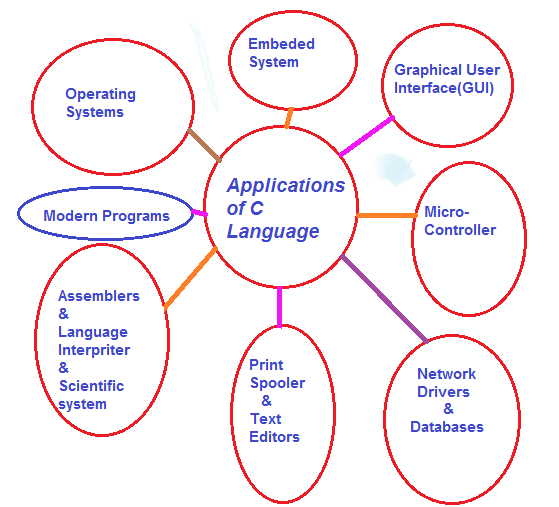
1. Operating Systems
Operating systems are the foundation of every computer. C is the language of choice for building operating systems because it gives developers direct access to hardware.
UNIX — the first major operating system — was built entirely in C. Later, Microsoft Windows, Linux, and Apple's macOS kernels were also written in C. Even Android apps rely on C at the system level.
💡 Fun Fact: The Windows Kernel, Linux Kernel, and Apple's OS X kernel are mostly written in C.
2. Graphical User Interfaces (GUI)
GUI stands for "Graphical User Interface." It's what makes modern computers easy to use — windows, icons, buttons, and menus. The term "GUI" was coined in the 1970s to distinguish graphical interfaces from text-based command lines.
Many popular applications are built with C, including:
- Adobe Photoshop — the world's most famous image editor
- Adobe Illustrator — professional vector graphics
- Adobe Premiere — video editing software
Every modern operating system has its own GUI. Applications like Microsoft Word, Excel, and web browsers (Chrome, Firefox) all use GUIs. When you open a website like Facebook or Instagram, you're interacting with multiple layers of GUI — the OS, the browser, the website, and even the video player.
3. Embedded Systems
An embedded system is a combination of hardware and software designed for a specific function. You'll find them in everyday devices — coffee machines, microwaves, car engine controls, medical equipment, and even high-end consumer electronics.
C is the most popular language for embedded systems because it provides optimized machine instructions. High-level languages often rely on large libraries that consume too much memory — a critical issue in resource-constrained embedded devices.
4. Modern Programs
C powers some of the most important software in the world today:
- Git — the version control system used by millions of developers
- Linux — the operating system that runs most of the internet
- MongoDB — a popular NoSQL database (written in C++)
- Node.js — JavaScript runtime built on C++
- Python and Ruby — both are written in C
- V8 — Google's JavaScript engine (written in C++)
- SpiderMonkey — Mozilla's JavaScript engine (written in C)
C is efficient, flexible, and can work at the highest levels of abstraction. That's why it's the foundation of so many modern technologies.
5. Compilers and Interpreters
Compilers are programs that translate code written in one language into another. C is widely used to create compilers for many programming languages.
Some well-known compilers written in C include:
- Clang C
- Bloodshed Dev-C
- Apple C
- MINGW
C's connection to low-level languages makes it ideal for building compilers that machines can understand efficiently.
6. Databases
Most relational and non-relational databases are developed in C or C++.
MySQL — the world's most popular open-source RDBMS — is written in C and C++. Oracle Database, one of the most powerful enterprise databases, is also built with C, C++, and Assembly.
7. Network and Device Drivers
Network drivers and device drivers are essential for communication between your computer and hardware devices. C is the preferred language for writing drivers because it can interact directly with hardware.
Examples of drivers written in C include:
- Keyboard drivers
- Network drivers
- Mouse drivers
- Graphics card drivers
💡 What is a driver? A driver is a set of files that helps your operating system communicate with hardware devices. Think of it as a translator between the software and the hardware.
8. Microcontrollers
A microcontroller (MCU) is a small, low-cost microcomputer designed to perform specific tasks. You'll find them in microwave ovens, car engine control systems, medical devices, and consumer electronics.
Embedded systems like coffee machines, climate control systems, and industrial devices are mostly programmed in C.
9. Text Editors
A text editor is a program that lets you create, edit, and view plain text files. While they started as simple note-taking tools, modern text editors are essential for writing code.
Many popular text editors and IDEs are built using C or C++, including parts of Visual Studio Code, Sublime Text, and Vim.
Frequently Asked Questions About Applications of C
1. Why is C used for system programming?
C gives direct access to memory and hardware, making it ideal for system-level programming like operating systems and device drivers.
2. What are the most popular applications built with C?
Operating systems (Linux, Windows), databases (MySQL, Oracle), compilers, embedded systems, and many modern programs like Git and Python.
3. Is C still used for GUI development?
Yes, many GUI applications like Adobe Photoshop and Illustrator were built with C. C++ is more common for modern GUI development, but C is still used.
4. Why is C preferred for embedded systems?
C is fast, memory-efficient, and can directly interact with hardware. High-level languages often require too much memory for resource-constrained embedded devices.
💡 Quick tip: Understanding where C is used will help you appreciate why it's still one of the most valuable programming languages to learn.